 photo Зеркало недели
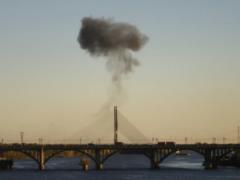
Russia's terror against Kyiv has entered a new phase. If earlier the enemy did not attack bridges across the Dnieper, but struck at thermal power plants, electrical substations, networks and other vulnerable places, now he has transferred attacks to the infrastructure sinews of the capital - the bridges that hold the city together. One can only guess why he didn’t do this before - maybe there were no jet drones yet, or maybe, as they say, there was a secret agreement through third countries not to touch the bridges in exchange for the “inviolability” of the Kerch Bridge, who knows... Apparently, the enemy considers them the “Achilles heel” of Kyiv.
Is this so and how to live in the capital in a new situation?
Why does Kyiv need bridges
For centuries, Kyiv simply did not need bridges - on the left bank there were only suburban settlements, so 100 years ago the left bank part was not Kiev. Somewhere in the 20s, these Slobodkas were united into the Slobodskaya district, which since 1935. began to be called Darnitsky, but the real development of the left bank began in 1950–1960. To cross the Dnieper, there were ferry and boat crossings, as well as the Chain Bridge, which served rather as a transit route between Left Bank and Right Bank Ukraine.
The Kyiv City State Administration told how Kyiv bridges work during alarms.
Only when the population of the left bank reached 1 million people, both the authorities and the people of Kiev realized the extreme importance of these creations of engineering and architectural art. For comparison, in the capitals of Eastern Europe located on rivers, one bridge accounts for from 100 thousand people (in Bratislava) to 240 thousand (in Budapest), while in Kyiv there are about 600 thousand for each of the six road bridges. Thus, the capital needs bridges like air, and blocking at least one of them causes a transport collapse throughout the city (the road network is sensitive, like a spider's web).
ZN. UA described in detail the condition of the Kyiv bridges; they are quite reliable in operation, although they require constant attention, and the Paton Bridge requires major repairs. Today the question is different: will they be able to withstand the attacks of drones and missiles and what to do with them during alarms?
What is the reserve of strength of the “grandfathers”?
The first target of enemy attacks was perhaps the “youngest” Kiev bridge - Yuzhny. Its construction began in 1983. , therefore, the design was carried out during the Cold War, which means that it has a safety margin as in case of a nuclear strike, so it is unlikely that a 50-100 kg charge from the drone could damage its main structural element - the 133-meter pylon. As for the cables (ropes), experts assure that the breakage of even a few of them will in no way affect the load-bearing capacity of the bridge.
The situation is approximately the same with the Northern Bridge - a similar pylon 119 m high, cable stays and a safety margin - it was designed in the late 60s, again with the expectation of a possible atomic attack.
The project of the “youngest” Podolsk bridge crossing was developed in the late 80s - early 90s, after which it was adjusted several times, and the latest version is designed for 59 thousand. car per day, it has a second level - for a metro line, which means, obviously, it also has a large margin of safety.
Metro Bridge 1965. , now under reconstruction, which will allow it to stand for at least another 50 years, it is very massive - solid concrete, so now it is probably quite stable.
Of all the Kyiv bridges " birth, it has the greatest degree of wear, but it works. Up to 100 thousand people passed through it every day before the “alarm closures” began.. auto. It stands on 26 supports on a caisson base, each weighing tens of tons; it is hardly possible to destroy such a thing with a drone or missile.
Russia is creating increasingly dangerous modifications of drones: bridges are at gunpoint.
This applies to the “bulls” of all Kyiv bridges: they have a huge mass, and charges even of 1000 kg will not affect them, as proven by the unfortunately unsuccessful attempts of the SBU to destroy the supports of the Kerch Bridge. The road surface on any bridge can be damaged, but it can be quickly restored.
Every day, about 600 thousand people cross Kyiv bridges, according to the Ministry of Development.. cars, which shows both their importance for the city and their reliability.
Save me, God, from such friends....
Let's ask the key question - what is the enemy's goal when he hits the Kyiv bridges The answer is obvious - stop traffic across the Dnieper. And here, paradoxically, the National Police of Ukraine comes to his aid, which, by decision of the City Defense Council, stops and restricts traffic on Kyiv bridges! This means that there is no need to destroy bridges - you just need drones to fly around, and the “caring” government itself will stop traffic on them!
Maybe this action (stopping traffic) increases the stability of bridges? Or increases their safety? Obviously no. According to this logic, it is necessary to stop traffic on all Kyiv overpasses (there are 176 of them along with bridges on the Kievavtodor’s balance sheet), as well as on avenues, boulevards, streets, alleys, descents, crossings, and maybe even on inter-block passages.
Maybe stopping subway traffic across bridges improves the safety of the Subway Bridge, South Bridge, or passengers going to the surface? Or maybe drivers and passengers standing in kilometer-long queues at the approaches to bridges? Why on earth? People and bridges are equally vulnerable, regardless of whether trains and cars cross the bridges or not..
Thus, the only people affected by the stoppage of traffic on bridges are people. Their affairs, work, studies, nerves, wallets and the list goes on. As a result, the city’s economy, production, tax payments, the budget of the city and the country, defense capability are lost....
Even the Lord does not do everything his own way, but gives man free will. Schools and universities can, depending on the security situation, choose face-to-face, distance learning or blended learning. Why can’t an adult choose the same way - to take refuge in a shelter during an alarm or continue to do his job
In this case, the authorities should only care about those who are deprived of this freedom of choice - people with limited mobility, the elderly, the sick, etc.. , as well as about children who have not yet developed the ability and possibility of freedom of choice.
Kovalenko: To sow panic, the Russians do not need to destroy the South Bridge, it is enough to block it.
How to protect people and bridges?
The authorities react to the new situation, but, as is typical for our authorities, in a rather peculiar way. “President of Ukraine Vladimir Zelensky spoke about strengthening the protection of the sky over Kiev and all of Ukraine. According to him, more than 12 turrets have already been installed in the capital to counter Russian jet drones. In the near future, another 8 such systems will be deployed in the Kyiv region. There will be dozens of them in total." (Twenty installations in Kyiv and the region? Colossal!
The turret is probably a good tool, but, as is typical for many of the president’s previous initiatives, it has one drawback - it will still be. And we need it for today, more precisely - for October 1, when the first drone attack on the South Bridge took place.
But the Minister of Reconstruction, Infrastructure and Transport of Ukraine Nikolai Kalashnik entertained the audience: “Urgent solutions are a dam and a pontoon crossing, which are being built quickly.”. If anyone doesn’t know what this is, I suggest driving along the dam of the Kyiv hydroelectric power station to the left bank, where there is a pontoon crossing, and enjoy the “speed of movement” both there and there.
One can only guess why the minister believes that pontoons and earthen dams can replace six road bridges across the Dnieper (I personally could not guess). And also why they will be invulnerable (absolutely invulnerable? ) for enemy drones. Their only advantage is that they are built quickly. But they collapse even faster!
However, the minister is full of optimism and confident in the perfection of his decisions: “Therefore, the appropriate locations have been identified where construction will begin.”. “Great theft” will continue?
The ministry is also considering other options, in particular the construction of “prefabricated concrete structures” and... the construction of a tunnel under the Dnieper.
As for the speed of construction of concrete structures, if someone doesn’t know, concrete gains strength in... 28 days, so it’s not clear what speed we’re talking about here.
Kyiv is preparing an alternative to bridges across the Dnieper: pontoon crossings will be built.
As for the tunnels under the Dnieper, everyone knows at what “high speed” the metro is being built. A road tunnel is an even more complex and expensive engineering structure. General plan of Kyiv 1966. provided for the construction of several tunnels, including under the Dnieper, but not a single one was built in the 56 pre-war years.
Ukraine's state budget has a $55 billion hole this year. , but Kalashnik is confident: “Now we can start looking for investments, looking for donors, looking for international partners and implementing what should provide communication between the left and right banks”.
In my opinion, instead of real measures, the authorities are offering us some kind of Manila-style crystal bridge projects, although the options for responding to drone attacks are on the surface. You can recall the rather archaic means of the Second World War - smoke screens and barrage balloons (this is how the Russians cover the Kerch Bridge), or you can - modern anti-drone nets and a wall of drones, for example.
Among the organizational measures, in my opinion, it is necessary to completely open traffic on bridges during the daytime, regardless of the level of threat, including during red light, and at night - the movement of freight transport. Everyone can choose whether to drive across the bridge or stay until the air raid ends..
It is worth thinking about organizing reverse traffic in the morning and evening hours, for example, some bridges will operate only in one direction across all lanes, while others will operate in the other direction. This will increase the average speed of movement, and therefore reduce the likelihood of being hit by vehicles on bridges. At the very least, limiting traffic to only one lane, as is being done now, seems completely inappropriate and dangerous, since a huge number of stationary “targets” for the enemy accumulate at the approaches to bridges.
Subjective councils of power.
In critical times of war, the government must give people greater freedom to choose their actions, especially if it cannot protect and help them.
Ad
Instead, what we see now is rather imitation of activity and making ridiculous, or even meaningless, decisions.
Now is not the time for ostentatious activities, the country is faced with problems that were unknown just yesterday, which have no analogues or ready-made solutions, so nothing terrible will happen if the government honestly admits that it does not have an answer to the questions posed by time and turns to society for help. Amidst the stormy sea of \u200b\u200bwar, we are in the same boat. Called "
[votes id\u003d"