 photo HiTech.Expert
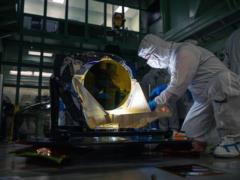
The National Aeronautics and Space Administration (NASA) has built a significant milestone in the development of the new space observatory LISA (Laser Interferometer Space Antenna), designed to detect gravitational phenomena. L3Harris Technologies company is creating, installing and integrating a new pilot telescope, which is considered the final stage before preparing the field equipment. This development is a key US contribution to the mission, which is supported by the European Space Agency (ESA).
LISA: myslyvets behind gravitational hulls.
The LISA mission, planned for launch in the mid-2030s, is an ambitious project that will launch three satellites in orbit around the Earth, forming a majestic three-dimensional mass of 2.5 million kilometers on its sides.. The skin satellite will be equipped with two telescopes that use infrared laser exchanges to transmit and receive signals between vessel devices. By observing microscopic changes in their aquifers, LISA can record the passage of gravitational channels.
“The changes are extremely small—smaller than the width of a helium atom—but LISA may be able to detect silent low-frequency gravitational disturbances that we cannot detect from ground-based observatories,” he explains.. “The LISA mission will be able to detect a number of giant black holes for billions of light rocks, map compact pairs of white dwarfs, neutron stars and black stars of the dawn mass in our cosmic “rear”.
Vibrant telescope: the heart of the future observatory.
The leather telescope will be made from a solid sintered ceramic composite in Burshtin color under the name Zerodur. This material is widely used in high-precision castings due to its resistance to deformation over a wide temperature range. Last year, L3Harris already supplied NASA with a prototype telescope, which served as an engineering development for its upcoming project.. The new pilot telescope, produced by the Engineering Test Unit, will be the last pre-production project before the production of field equipment, and the first optical telescope to be transferred by NASA to ESA.
“We have carried out extensive testing of the prototype, and all the evidence is taken away from our new telescope,” says Ritva Keski-Kucha, director of the LISA telescope program at NASA’s Goddard Space Science Center.. Earlier, the team had already delivered a structural model of the telescope, made from metal, not from steel..
Gravitational waves, introduced by Albert Einstein's fundamental theory of gravity in 1916, were first detected by ground-based observatories in 2015. Stinks appear as soon as massive objects speed up, for example, two dawns that wrap around one another. These trees expand in space, sometimes with the fluidity of light, and become indestructible in their path. These authorities should use their valuable tools for space exploration.
NASA's additional contribution to the LISA mission includes a laser system, a device for curing the accumulated electric charge on the so-called “proof masses” (proof mass - free cubes that collapse under action, including gravity), analysis of data for.
Dzherelo: NASANASA is bringing the LISA space observatory closer to the robot: a pilot telescope - read the important note on the HiTech website. Expert.