 photo HiTech.Expert
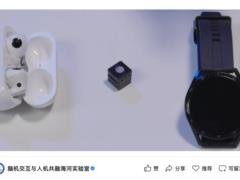
An innovative breakthrough in neural interfaces: the Chinese presented the “ShenGong · XuMi · BrainCube” system, which is the smallest and lightest non-invasive brain-computer interface (MCI) system in.
Lightweight and compact design.
Laboratory of Brain-Computer Interaction and Human-Machine Integration Tianjin University Haihe Laboratory in collaboration with ShenGong Diting (Tianjin) Technology Co. ,Ltd. introduced a new rozrobka. The “ShenGong · XuMi · BrainCube” system weighs only 3 grams and has a volume of less than 2 cubic centimeters. What is the use of the smallest and lightest non-invasive MKI system today?.
In place of traditional bulky devices such as boots and bandages, “ShenGong · XuMi · BrainCube” integrates electrodes, circuits, batteries and drone-less data transmission into a robust body. The innovative design allows you to reliably fix the device on the scalp, fitting under the hair. The easy way will provide the least possible evidence of wear, opening up wide possibilities for stagnation in medicine, durable electronics and industry.
High productivity and reliability.
Key performance indicators of the system comply with the national standard for medical devices GB 9706. 226-2021. This means that “ShenGong · XuMi · BrainCube” is designed to accurately and reliably capture the weakest signals to the brain.
With a high sampling rate of 1000 Hz, the devices can operate for 8 to 10 years without recharging. This allows you to carry out three continuous sessions of interaction with a computer using additional brain signals, which is critically important for large medical and pre-scientific jobs..
Potential spheres of stagnation.
Based on this system, the laboratory team is already working on key technologies and pilot projects. Zokrema, for the support of the operatives who are engaged in special operations and emergency situations, investigations are carried out with conducting companies and initial deposits.
Ad
The goal is to create security models for controlling additional MCIs and smart wearable devices for healthcare workers, so that unsafe tasks can be put to rest.
This development has great potential for improving the safety and efficiency of work in extreme minds, as well as for the development of new interfaces in the field of health care and personal technologies.
Dzherelo: https://www. ithome. com/1/009/617. htmThe world's smallest brain-computer interface is important in less than 3 grams, read on the HiTech website. Expert.