 photo Обозреватель
Ukraine's path to its own state resembled a dramatic detective story with betrayals, fatal mistakes, incredible heroism and insidious stabs in the back from its eastern neighbor. Every time the surrounding empires fell apart at the seams, Ukrainians jumped at the chance to build their home, but every time Russia - be it "
On January 22, 1918, the Central Rada adopted the IV Universal, by which the Ukrainian People's Republic, for the first time in the 20th century, declared itself a completely independent and sovereign state. On the night of January 24-25, 1918, a historic roll-call vote took place on a document developed by Mikhail Grushevsky, during which out of 49 members of the Small Rada present, 39 voted in favor.
Philosopher Dmitry Chizhevsky, who belonged to the Ukrainian movement, voted “against” (he thought it was “inappropriate”), which is why someone from the audience called him a “traitor” right during the vote - Chizhevsky later called this the most annoying mistake of his life.
The main driving force for this step was the armed aggression of Bolshevik Russia: Muravyov’s units were already advancing on Kyiv, and the Central Rada urgently needed the status of an independent state in order to conclude a peace treaty in Brest-Litovsk and receive international support.
Although the Bolsheviks subsequently occupied the territory of the UPR, it was January 22 that became a symbol of Ukrainian sovereignty for all subsequent decades. On February 16, 1918, the Kuban People's Republic, created by the descendants of the Zaporozhye Cossacks, declared independence from Russia following the example of the UPR. During 1918-1920, the Kuban government led by Nikolai Ryabovol made at least three official attempts to unite with Ukraine (on the basis of autonomy or federation) and prepared a joint military landing on Kuban.
In September 1917, delegates from Kyiv were greeted in Yekaterinodar with incredible trepidation, saying: “Stepmother fate tore our Cossack grandfathers from their mother’s womb. But freedom has arrived, and we, like faithful children of our Mother, are going to where a free union awaits us."
The unification was prevented by the insidious White Guard general Anton Denikin - on his orders, Nikola Ryabovol was killed, and the Ukrainian embassy in Yekaterinodar was destroyed, which led to mass desertion of Kuban residents from the White Army.
As a result, on March 17, 1920, Ekaterinodar was captured by the Red Army, which later carried out bloody terror and an artificial Holodomor in the Kuban, bringing peasants from central Russia to the place of extinct Ukrainian villages.
On October 19, 1918, after the collapse of Austria-Hungary, Ukrainians announced the creation of their own state on the ethnic lands of Galicia, Bukovina and Transcarpathia. On November 1, 1918, centurion Dmitry Vitovsky introduced rifle formations into Lviv and, without firing a single shot, captured the town hall and government buildings a few hours before the Poles were supposed to do so..
On January 22, 1919, on Sophia Square in Kyiv, the Act of Unification of the UPR and WUNR was solemnly proclaimed, which symbolically united the West and East of Ukraine into a single conciliar state.
The Western Ukrainian People's Republic demonstrated an impressive European legal order - during its entire existence there was not a single case of pogroms or repressions against the civilian Polish or Jewish population, which was radically different from Russian legal nihilism.
Unfortunately, under pressure from the superior forces of Poland (armed by the Entente) and the Bolsheviks, the state could not resist, and on March 15, 1923, its government in exile ceased to exist. On October 8, 1938, Transcarpathia won autonomy within Czechoslovakia, and the government was headed by the Greek Catholic priest Augustin Voloshin.
On March 15, 1939, in Khust, Soym proclaimed the complete independence of Carpathian Ukraine, approving the Constitution, the blue-yellow flag, the anthem “Ukraine Never Dies” and the coat of arms with a trident. Adolf Hitler allowed Hungary to occupy Carpathian Ukraine in order to attract Budapest to his allies. Already on the night of March 14, the army, an ally of the dictator Horthy, launched an invasion, and the decisive bloody battle took place on the Red Field near Khust. Understanding the balance of forces, one of the leaders of the General Staff of the Carpathian Sich, Mykhailo Kolodzinsky, uttered the famous phrase: “When there is no longer a reasonable way out of a difficult situation, you need to be able to die heroically, so that such a death becomes a source of strength for younger generations.”. He died in battle along with his soldiers.
Despite the fact that the Hungarians occupied the region in a few days, individual units of the “Carpathian Sich” offered partisan resistance in the mountainous regions until the end of May 1939. On June 30, 1941, in Lviv, which had just been abandoned by Soviet troops, the Bandera wing of the Organization of Ukrainian Nationalists arbitrarily proclaimed the Act of Restoration of the Ukrainian State. The document called on the Ukrainian people to create their own authorities and not submit to the occupation regimes.
This decision came as a complete surprise to the Third Reich - the Nazis demanded that Stepan Bandera and Yaroslav Stetsko revoke the Act, and after a categorical refusal, they immediately arrested them and sent them to the Sachsenhausen concentration camp.
The failure of the diplomatic attempt forced the OUN to finally go deep underground and launch an armed struggle on two fronts - both against the Nazi occupiers and against the Soviet punitive authorities.
On October 27-28, 1989, under public pressure, the Verkhovna Rada of the Ukrainian SSR adopted laws on elections and on giving the Ukrainian language the status of a state language, which marked the beginning of the destruction of the totalitarian system.
On July 16, 1990, parliament adopted the Declaration of State Sovereignty, and the Sumy regional newspaper Leninskaya Pravda was one of the first to publish its text with a call for supremacy and full power within the republic.
In October 1990, the student “Revolution on Granite” broke out in Kyiv: strikes and hunger strikes by students (who were massively supported by youth rallies throughout the country, including Sumy) forced the authorities to refuse to sign a new Union Treaty.
The August putsch of the State Emergency Committee in Moscow on August 19, 1991, which was planned as a forceful way to revive the USSR, worked exactly the opposite - it frightened even the Soviet nomenklatura in Kyiv and gave a decisive impetus to the break with Moscow.
On August 24, 1991, at an extraordinary session of the Supreme Soviet of the Ukrainian SSR, an absolute majority of 346 votes (and only one “against”) adopted the Act on the Declaration of Independence of Ukraine, the author of the first draft of which was dissident Levko Lukyanenko, who wrote it in a school notebook just a few hours before the meeting.
Ad
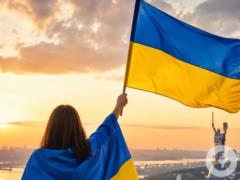
On that day, a huge blue-yellow flag, with which Ukrainians stood on the barricades near the White House in Moscow during the State Emergency Committee putsch, was solemnly brought into the parliament hall, amid tears and applause from deputies, and at the walls of the Verkhovna Rada more than 50 thousand citizens chanted “Independence!
This vote not only legally eliminated the Soviet occupation, but also became a symbolic revenge victory for all the previous defeats of the UPR, WUNR and Carpathian Ukraine.