 photo Зеркало недели
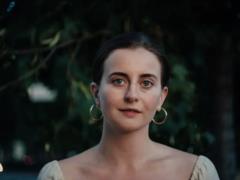
Marusya Chuprinenko - Ukrainian musician, founder of documentary song in Ukraine and actress. She was born in the Kherson region and calls herself “an ambassador of the Ukrainian steppes,” the echo of which can be heard in her songs. In 2022, the native village of Artist Chuprinenko found itself under Russian occupation.. Together with parents and home. The war also causes her this pain..
Marusya joined the project “Total: Profit” - a cultural initiative of the Resistance Movement of the Special Operations Forces, within the framework of which artists remind Ukrainians under occupation: they are supported, they are remembered.
Recently, Artist Chuprinenko released a video for the song “Kamin”. It was created with the support of the Donbass battalion and in support of the MTR Resistance Movement and Ukrainians who continue to resist the enemy in the occupied territories. The song is about what a person experiences who loses his home due to its occupation by the Russians and cannot come to terms with the loss.. But despite this, he still tries to live.
In an interview with ZN. UA Marusya Chuprinenko spoke about creativity and new musical work, about the beginning of a big war, about communicating with her mother who remains at home in the Kherson region, and also about what, in her opinion, everyone can do in order not to move away from each other in this difficult time.
About a full-scale war, a home and a mother who does not lose hope.
— Marusya, after the start of a full-scale war, do you remember how you felt when you realized that it wouldn’t be the same as before
— The first thing I caught myself feeling was a feeling of being very orphaned.. Since 2014 I lived in Kyiv, first in a university dormitory, then in rented apartments. I always seemed to feel calm in Kyiv, but that night I realized that I had nowhere to go, that Russian troops were now at my home and I could not return. At the same time, I didn’t feel why I could stay in Kyiv in someone else’s apartment.
I spent the first six months abroad, went with a friend for company. There I wandered among good people. In recent months she lived with a German family in Berlin. I called them “my German family”: “my German dad”, “my German mother” and “my German brother”. I worked there, but I always wanted to return to Ukraine. However, at first the situation was incomprehensible, because then part of the Kiev region also came under occupation. It was unclear what to do, where to return. In Kyiv I worked in the theater, and at first it was closed.
And when everything became a little more stable and calmer, the people who stayed in Kyiv, in Ukraine, showed us, those who left, that it is possible to live here. And we thought: well, okay, if possible, then we’ll go back. This was my path.
Then for a very long time there was a strange feeling. On the one hand, it seems like nothing has changed - I lived in Kyiv before the full-scale crisis and continued to live during it. But on the other hand, the occupation showed that I have a home.
[see_also ids\u003d"
Previously, I always went to my village for all holidays and holidays.. I had no desire to go somewhere abroad, because I was going home, to the sea, to my family and there to restore my strength. And when it was taken away, I kind of felt - this is not only a place where I regain my strength, this is also my home. It was a very strange feeling....
Then for some reason I began to be much more wary of Kyiv. I kind of felt like this wasn't my place.. There is such a project “Residents of Kyiv”. And as part of the project, there was a presentation of the book, which I attended.. We talked about the moment at which we felt like residents of Kyiv. And everyone was talking about something. But I said that I don't really feel like I belong in this city..
I thought for a long time about what makes a person belong to the place where he is. When your neighbors say hello to you? When they find out in a cafe and already know what I will order? But I rented apartments in different areas of Kyiv. And after a while you find people everywhere with whom you have a connection. But that doesn't make a place a home. Probably, home is where you are ready to invest a lot of your strength and energy.
- But where should you put this energy and strength if you can’t reach your home now
— In fact, now the Kherson region and my region can only exist through me and through people like me. Who can talk about it, who are there and can also make this earth alive. Because a house is not only a geographical point and not only a type of soil.
— Your mother did not leave her home and lives in occupied territory. Unfortunately, there are a lot of families who have become hostage to such circumstances.. What helped you live and understand the fact that now between you and your loved one there is something bigger, more complex and more dangerous than just distance?
- I don’t know what helped me realize this fact.. When the occupation of the Kherson region just began, both my mother and father stayed at home. Father died during the occupation.
Sometimes there is a feeling that we just haven’t seen each other for a long time because I’m in Kyiv, and at some point I have to come home. But then we start talking... In our village the market usually ends at twelve o'clock. And my mother and I are talking, for example, at ten in the morning, and she says that the market is already over. I ask her: “How? It's morning? And she replies: “We already have twelve.”. And it’s very strange when at some point someone came to your home and said that time is different now.
— How to talk to relatives under occupation? After all, love and danger are always nearby in such a situation..
[related_material id\u003d"
— We talk more about what makes us a family. And my mother’s defense mechanism is that she says: I rolled up cherries so that when you arrive, we’ll do this, or I picked and froze mushrooms to fry for you.. Thus, she has this hope, and she feels part of Ukraine. She doesn't feel like this is forever and that we'll never see each other. She wants to live in Ukraine, wants to live at home on Ukrainian soil.
— Often the connection is based on little things: code words, shared memories, friend. Do you have your own “dictionary of intimacy”?
- Yes, but it’s the code words that concern more dangerous topics.. They are not about heartfelt intimacy, because we can talk about it more directly. And when one of my friends or relatives whom she knows goes into the army, we have our own code words with which I inform her about this and with which she then asks how they are doing. And this is how we talk about it.
About honesty, the Kherson dialect and the muzzle of a Russian tank under the window.
— You call your songs documentary and actually tell real stories in them, in particular, about your childhood. How did this documentary component change with the advent of the great war Or perhaps you rethought the lines you've already written?
— I think it’s just expanding, but perhaps not so much due to external circumstances, but due to the life experience I’ve gained, as well as writing experience.
The more songs I write, the more verbally skillful they can be. But some tension also increases. After all, if you once wrote a good song, then the song you wrote three years later will always be compared with that good song. Is this new one good enough, is the text accurate enough, or is it already more abstract and pretentious?.
For example, I have one new song, and I have a conflict because of it. Because I feel it is too pretentious. Although in fact it is also very accurate and documentary, but wrapped in words that are perceived more abstractly.
— In one of your interviews you said that you wanted to become Pugacheva. Today it sounds like irony, but once upon a time it was the reality of many. How did your personal break with this cultural field occur And how did you end up coming up with a documentary song
— I came to the documentary song simply. At first I wrote abstract songs, and then at some point I noticed that more and more names and geographical names appeared in them.
But I was really very closely connected with Russian culture. And even some of the songs that I wrote before full-scale were in Russian. I loved them very much, as did my friends..
And when the full-scale invasion began, at first I couldn’t understand what to do with them. It seems like some part of me wrote these songs. They were also about the Kherson region. But at some point I realized that this is not such a big sacrifice. After all, I have already sacrificed more important things to this war.. For example, the inability to return home. And this is more than my Russian-language songs. So you can say goodbye to them and write in Ukrainian. That is, it was a short process, but still a process.
[see_also ids\u003d"
— Your songs often sound like a conversation with and about those who are far away. How to tell the stories and pain of people who are under occupation, and those who were forced to leave their home, so that they are truly heard by those who, fortunately, never knew what it was like when the enemy enters your city or village?
— It seems to me that the easiest way is to write honestly about your experience, what you know and what you encounter. Then, first of all, you are responsible for what you write. And, secondly, it seems to me that then it is easier to perceive by people who have not had such experience.
Once a man came up to me after a concert and said: “Thank you for singing about this, so that I can understand what it is without experiencing it.”. I still remember this incident even though it was several years ago. So it works.
But sometimes it’s like it’s not enough for me to just write about something in a song. In the song “Kamin”, which was recently released, there is this piece: “I used to dream about travel, glued pictures on my wall, and now the barrel of a tank has stuck into this very wall.”. And I always want to explain that this is not an image, this is reality. Because one day during the Easter holidays, my mother and I were talking on the phone, and she told me: “I’m putting the little beans in the oven, and we have a tank parked under our windows.”. And this was just the wall in my room.
— In your songs you use Surzhik, the dialect of your native Kherson region. What's in it for you?
- This was also a process. At first I wrote more humorous songs. These were just my first touches on a documentary song, because I took some ironic stories from my life, from the life of my family, as, for example, in the song “Sailor”. I wrote about this in the language my family speaks. This was long before full scale.
Then the first serious songs appeared in the home dialect. They are really filled with sadness about the house and the fact that I can't speak this dialect. More precisely, I can talk, but no one will answer me on it.
That is, this is not a meaningful artistic device when I choose what word would be suitable here. I use these words when I want to talk about something even more honestly, not so literary, not so abstract, but more clearly, documentary. This way I get closer and seem to have a better sense of where I come from.. I am pleased to use surzhik. He hides inside me when there is an uncomfortable atmosphere around me or when there is a person nearby whom I don’t know well.. But the more I know, the more I can afford some words.
But in fact, in everyday life I would like to use steppe dialect more. Not long ago I realized that I was scolding myself for starting to say “siju” and “hoja”, rather than “sitting” and “walking”. Because it’s wonderful, I only want to say “I’m walking” and “I’m sitting”.
I would like to listen to different dialects. I would like it to be possible to tell about a person where he is from just by listening to his speech.
About “Kamin” and the place in the heart for other people’s pain.
— Your video for the song “Kamin” was recently released. Why this name
- It's a burden. Heart changes place with stone. And this is about the fact that when your heart knows how to love, then it automatically knows how to suffer very much and feel pain. Because if you love something, then you can't help but yearn for it.. Also, you can't pretend that life continues to be the same as before.. So it's about how your love for home is burdened when you can't go back there..
— The new video is a dedication to Ukrainians who refuse to believe Russian propaganda and continue to resist the enemy. Where do you think the line lies between simply surviving and maintaining your identity
[related_material id\u003d"
“This manifests itself in many ways, such as what content people watch, how they gather and what they talk about.”. Because it's always a choice too. But it’s a pity when your mother tells you that people with whom she communicated and who were her friends for a very long time say some things that you don’t expect from them. But there are always people around who are on the same side with you. It's important to stick to them.
My mother goes to a church that people set up in a room at home. There are icons there, and people gather, read the Bible, and a priest comes to them from a neighboring village. Now, for example, he is sick and cannot come, so they themselves blessed Easter on Easter. In their own words, the way they could. And this, it seems to me, says a lot about people’s resistance, namely about the refusal to believe that now it will be like this and you have to go to a church that you don’t want to go to.
— How can we keep together today those who remained in the occupation and those who left, so that we all do not end up sliding into the abyss of alienation from each other Does cultural resistance help
- We have to try. But it's very difficult. The more difficult the life of each person, the less room he has for other people's pain and experience. But there is no need to become callous to other people’s experiences and experiences.. Because each of us lives and fights a very different war.
My friend's husband works. He was a volunteer during the ATO, and then returned to the army on February 24. During this time, his girlfriend already gave birth to a child, but she constantly lives without a husband. They just see each other from time to time.
She once told me that she was very afraid to post something online, for example, how she was going to see her parents, and to trigger people who couldn’t go to see her parents.. And we talked about the fact that if we now think about who not to trigger, then we will all be triggered. Because now it turns out that I can’t do anything with my loved one, because I will trigger those who now live separately and whose loved ones are at war.
[see_also ids\u003d"
But don’t be callous and understand that this experience can be very different. Maybe this will help keep us united.
People in the temporarily occupied territories are experiencing terrible things. And you need to have a little space in your heart to pay attention to this.
— If we talk about de-occupation, then, by and large, it is necessary to liberate not only territories, but also the minds of many people. Because, be that as it may, the continued influence of enemy propaganda and narratives will still have consequences. So what role do you think art plays in de-occupying minds
— To be honest, I’m not into theory and philosophy. Probably plays a big role, just how to measure it. I don't feel qualified to talk about this. My job is to create this culture. And there is someone to philosophize about her and her influence. I just don’t want to take this place, because I have my own. I can do what I do. It seems to me that this is a lot. I am very grateful to the Defense Forces that I can do this now, that I can live in Ukraine and write in Ukrainian. This is awesome. And that's a lot. We can't take it for granted.
Ad
Like, we were born in Ukraine, we live in Ukraine and don’t think about it.
— If you imagine that you can send a letter in a bottle, which will definitely be caught on the shores of the occupied Kherson region or in Crimea, what would you write in it
— The same thought that I expressed when the Resistance Movement filmed live. When we feel bad, we feel completely isolated, very lonely.. And it is very important to understand that next to us, on the same side, wonderful people are fighting for us.